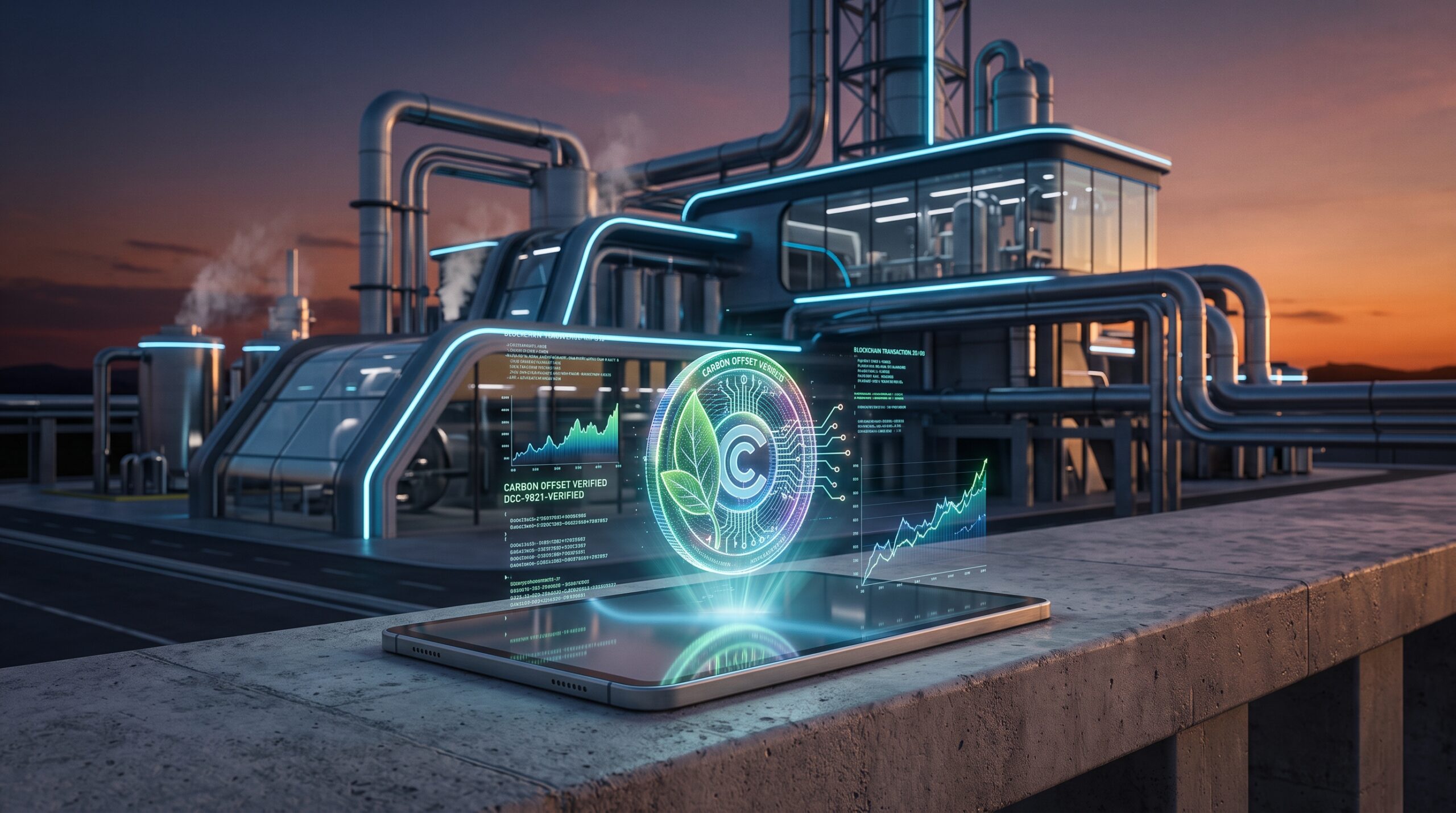
The voluntary carbon market has historically operated like an opaque, fragmented relic of early Web 1.0 infrastructure. For synthetic e-fuel and green hydrogen manufacturers, this operational friction represents a massive, multi-million dollar liquidity drain. Under legacy frameworks, a clean fuel plant must wait months for third-party validation bodies to manually verify their carbon offsets, only to watch brokers take massive cuts on over-the-counter trades. This prolonged validation lag ties up essential working capital that could otherwise be deployed immediately into scaling up industrial infrastructure.
The intersection of Web3 ledger technology and sustainable manufacturing is completely dismantling this bottleneck. By converting physical, fragmented carbon avoidance metrics into programmable digital assets, clean energy companies can now verify and monetize their environmental impact in real time. This evolution directly transforms carbon accounting from a cumbersome regulatory chore into a high-yield financial tool. As institutional capital pours into high-value clean tech sectors, developers who leverage on-chain architecture are securing a massive competitive advantage in market liquidity and corporate trust.
The Mechanics of On-Chain Carbon Credits for Alternative Fuels
To understand the scale of this disruption, we must look at how a physical commodity transforms into a secure digital asset. E-fuel plants use advanced direct air capture (DAC) and green hydrogen infrastructure to synthesize zero-emission hydrocarbon replacements. Every metric ton of carbon dioxide captured and successfully sequestered or utilized generates a highly valuable environmental claim. In the legacy model, this claim becomes a paper certificate; in the modern tokenized ecosystem, it undergoes a secure “bridge and mirror” architecture.
The physical credit is permanently locked in a traditional legacy registry like Verra or Gold Standard to absolutely prevent double-counting. Simultaneously, an institutional-grade smart contract mints an exact “digital twin” token on a public blockchain network. This token acts as a highly liquid asset that holds complete cryptographic proof of its origin, vintage year, and environmental impact. Because these digital assets follow standardized token guidelines, they can be instantly fractionalized or traded 24/7 across global decentralized marketplaces without relying on hidden broker networks.
Driving Up Asset Value: Bridging Liquid On-Chain Capital to Heavy Hydrogen Assets
This tokenization process does not just improve administrative transparency; it opens direct pipelines to massive, yield-bearing capital markets. In the traditional finance world, institutional investors are often hesitant to back early-stage clean fuel plants due to the long, illiquid investment horizons. By tokenizing the future environmental yields of these projects, developers can essentially pre-sell their carbon offsets to a global pool of automated buyers. This provides immediate non-dilutive financing to fund heavy infrastructure expenditures, such as scaling up multi-megawatt electrolyzers or purchasing advanced high-pressure storage tanks.
Furthermore, these cryptographic tokens are unlocking entirely new corporate use cases, such as hourly environmental matching. Tech-heavy industries and high-intensity artificial intelligence data centers are actively seeking automated carbon offsets that match their energy consumption down to the exact minute. A smart contract can automatically purchase and permanently retire tokenized e-fuel credits whenever local green energy grids dip. This automated institutional demand creates a reliable price floor, which naturally attracts major banks who are now accepting high-grade carbon tokens as low-risk collateral for sustainability-linked corporate loans.
Eradicating the Greenwashing Threat Through Immutable dMRV Systems
The biggest threat to the valuation of any carbon offset asset class is the persistent risk of corporate greenwashing and fraudulent double-spending. If a project developer accidentally or intentionally sells the exact same metric ton of carbon reduction to two separate buyers, the underlying value of the entire asset class collapses. This is precisely where the decentralized ledger proves its structural superiority. When an organization decides to use a tokenized credit to offset its emissions, the token is permanently “burned” or retired via a smart contract, creating a permanent, unalterable public public ledger entry that cannot be reversed.
To elevate asset integrity even further, advanced platforms are integrating digital Monitoring, Reporting, and Verification (dMRV) systems. Instead of relying on manual, yearly field audits that are prone to human error, modern clean fuel facilities feed automated data from physical IoT sensors and environmental software directly into blockchain oracles. This means a token’s metadata updates in real time based on actual factory output and verify compliance instantaneously. Institutional buyers are paying a substantial premium for these high-integrity assets because they completely pass the most stringent international regulatory audits.
Maximizing Yields: A Strategic Framework for Sustainable Digital Asset Portfolios

Navigating this rapidly evolving convergence of decentralized finance and industrial clean tech requires a highly disciplined, risk-managed allocation framework. For family offices and retail investors aiming to capture top-tier returns, the optimal strategy involves backing the underlying infrastructure layer. Rather than speculating on highly volatile, unverified carbon tokens, capital should be directed toward established platforms that build the actual interoperable bridges connecting traditional registries to public blockchains.
Additionally, a highly profitable tactical move involves tracking large-cap industrial companies that are aggressively purchasing long-term on-chain carbon options. These companies understand that as carbon taxes tighten globally, the open-market cost of high-integrity, digitally verified credits will skyrocket over the next decade. By securing exposure to tokenized carbon pools early, you are not just participating in a cutting-edge technological upgrade—you are positioning your capital directly in front of a multi-trillion dollar institutional liquidity migration.
FAQ
What exactly prevents a tokenized carbon credit from being sold twice?
The immutable structure of the blockchain completely eliminates the double-spend problem. The moment a carbon token is purchased and used to offset an emission, a smart contract executes a permanent “retirement” function that burns the token, removing it from circulation forever and leaving an unalterable public audit trail.
How does this technology directly help a green hydrogen or e-fuel factory?
It completely skips the slow, expensive broker networks by allowing producers to instantly tokenize and sell their environmental offsets directly to global buyers. This unlocks immediate, non-dilutive capital that factories can use to purchase heavy equipment and accelerate their industrial scaling.
Are institutional investors actually buying these digital carbon assets?
Yes, major financial institutions and multi-billion dollar data center operators are actively adopting tokenized credits. They utilize these programmable assets to execute automated, real-time ESG compliance and hourly carbon matching, which is virtually impossible to achieve using manual legacy paperwork.
Leave a Reply