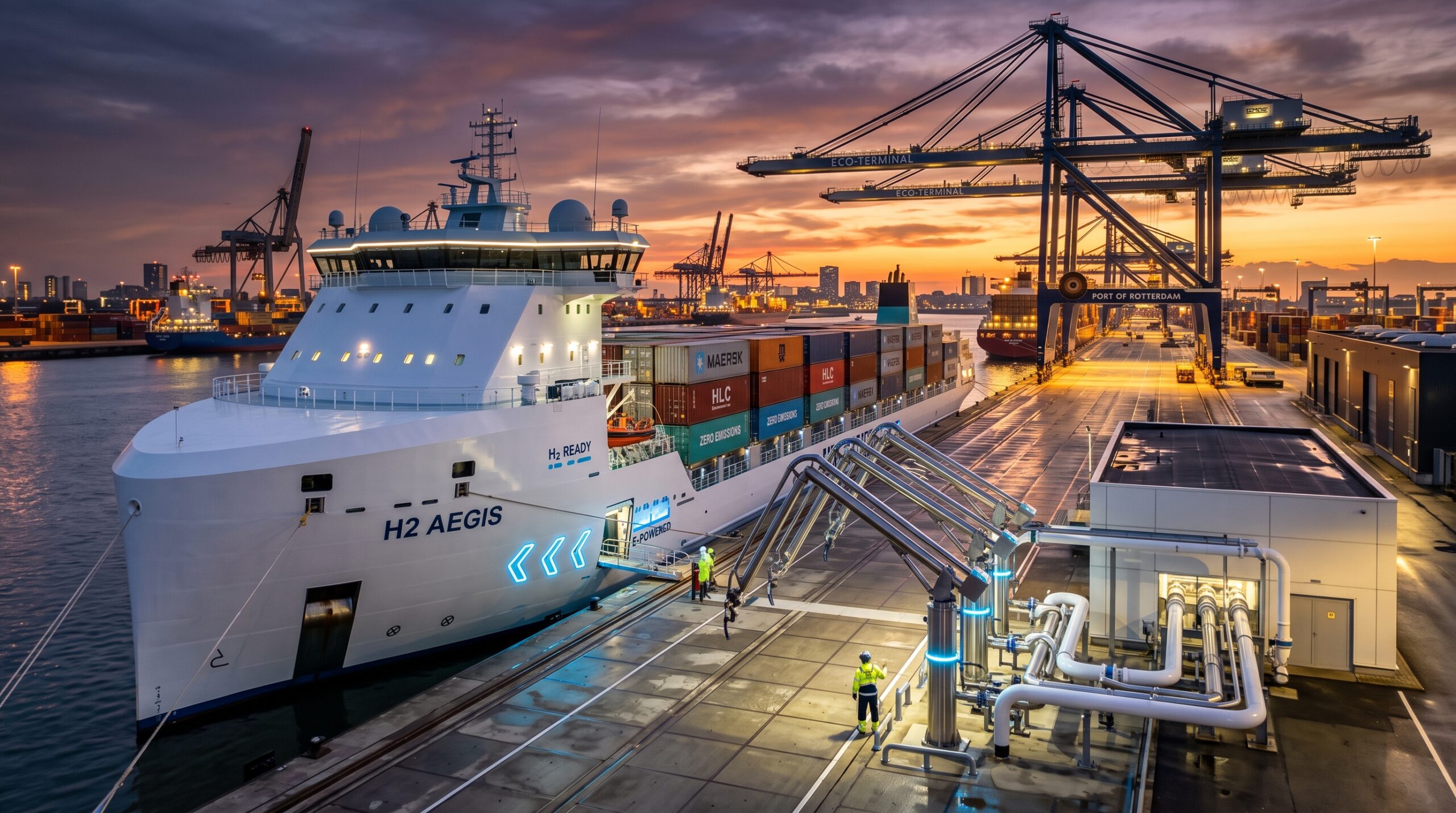
The international maritime sector is facing an existential environmental reckoning that cannot be solved by battery power or basic liquid natural gas. While terrestrial transport sectors have successfully pivoted toward electrification, deep-sea cargo vessels and massive container ships are restricted by a brutal volumetric reality. To cross the Pacific or Atlantic oceans, a commercial vessel requires an incredibly dense, stable fuel source that doesn’t consume half its cargo capacity just for energy storage. This hard constraint has left global fleet operators scrambling for a scalable, zero-emission fluid that integrates with existing maritime trade lanes.
The global green ammonia market size is expanding rapidly to fill this critical logistical vacuum, with projections showing it scaling toward a multi-billion dollar asset class over the next decade. By synthesizing nitrogen captured from the air with green hydrogen generated via water electrolysis, producers are creating a completely carbon-free fuel. The true magic of this molecule is its superior storage chemistry compared to pure liquid hydrogen; it liquifies at a manageable minus 33 degrees Celsius and holds nearly double the volumetric energy density. For institutional capital looking to invest in maritime alternative fuels, this specialized chemical segment represents the single most strategic hedge against coming international carbon penalties.
Tracking the Maritime Micro-Signals: Regulatory Surcharges Driving Fleet Re-Engineering
The underlying commercial thesis for ammonia energy stocks has shifted from a speculative environmental theory into a legally mandated industrial reality. The International Maritime Organization (IMO) has firmly committed to reaching net-zero greenhouse gas emissions for global shipping by or around 2050, introducing stringent intermediate targets along the way. These structural baselines are accelerated by localized regulatory hammers, such as the FuelEU Maritime framework and the inclusion of shipping into the European Union Emissions Trading System.
These legislative adjustments are essentially placing a massive, permanent penalty on traditional heavy fuel oil, completely altering the financial calculus for global logistics. Ship owners are no longer asking if they should transition, but rather which asset class will protect their balance sheets from terminal obsolescence. Consequently, major engine builders like MAN Energy Solutions and Wärtsilä are already delivering commercial-grade, dual-fuel ammonia engines to shipyards. Because a typical commercial vessel has a twenty-year operational lifespan, the ordering boom happening today guarantees a massive, multi-decade demand pipeline for low-carbon chemical producers.
Mapping Global Logistics: Port Readiness and the Leverage of Agricultural Supply Chains
A common roadblock for most emerging clean tech assets is the complete lack of distribution infrastructure, requiring trillions in greenfield infrastructure buildouts. Green ammonia completely bypasses this initial commercial barrier by leveraging a deeply entrenched, pre-existing global agricultural network. The international chemical industry has traded, stored, and transported millions of tons of conventional ammonia for over a century, primarily for nitrogenous fertilizer production.
| Infrastructure Attribute | Conventional Petroleum | Green Ammonia Advantage |
| Global Port Availability | Universally Mature | Over 120 international ports already feature functional ammonia terminals |
| Onboard Space Penalty | Baseline Standard | Requires roughly 3x to 4x the volume of fuel oil, but half that of liquid hydrogen |
| Regulatory Framework | Fully Standardized | Initial IMO interim safety guidelines established; binding codes entering force |
This established footprint gives the sector a monumental head start in the race to scale global bunkering operations. Instead of inventing entirely new industrial supply chains from scratch, operators are simply retrofitting existing industrial port terminals with green production facilities, such as the multi-gigawatt NEOM facility in Saudi Arabia. As these supply corridors expand, early-moving ports are establishing dedicated green shipping corridors that lock in exclusive regional distribution rights. This structural positioning allows infrastructure owners to command substantial price premiums from commercial fleets desperate to avoid carbon compliance penalties.
Navigating the Commodity Desk: Toxicity Risks and Price Parity Curves
Every high-yielding investment thesis must be systematically weighed against its specific physical vulnerabilities and economic hurdles. For ammonia, the primary operational challenge is not flammability, but its acute chemical toxicity to human health and marine ecosystems. A significant onboard fuel leak could have severe safety consequences for a ship’s crew, requiring advanced double-walled piping systems, automated scrubbing technologies, and rigorous crew handling certifications.
Furthermore, the green shipping commodity trends show a massive price premium today, with green variants trading significantly higher than standard marine gas oil. This cost discrepancy is driven entirely by the high capital expenditures required for advanced proton exchange membrane (PEM) and alkaline electrolyzers. However, this pricing premium is projected to narrow drastically over the next ten years as global carbon taxes escalate and renewable energy generation drops in cost. Forward-thinking commodity desks are already capitalizing on this trajectory by structuring long-term off-take agreements, effectively locking in future supplies before industrial demand outstrips global production capacity.
Capital Allocation: Designing an Institutional Green Shipping Portfolio
Capitalizing on this maritime energy transition requires a highly sophisticated, multi-tiered investment approach that balances hardware innovation with infrastructure stability. For asset managers seeking top-tier exposure, the primary defensive layer should consist of dominant agricultural chemical giants that are aggressively pivoting their legacy assets toward clean synthesis. These institutional titans possess the cash reserves and regulatory expertise necessary to absorb early technology risks while scaling production volume.
A smaller, tactical allocation should be directed toward pure-play electrolyzer manufacturers and advanced maritime engineering firms holding proprietary patents for ammonia fuel cells and safety systems. By diversifying across the entire production and distribution value chain, you insulate your capital from localized factory delays while maintaining massive upside exposure to the broader decarbonization wave. As institutional liquidity continues its generational migration into sustainable infrastructure, positioning your capital in front of this marine fuel revolution offers one of the most resilient growth profiles in the macro energy landscape.
FAQ
Is ammonia safe enough to be used as a mainstream ship fuel?
While ammonia is highly toxic and demands strict handling protocols, the global maritime industry has safely transported it as commercial cargo for decades. Modern newbuilds are integrating automated monitoring, double-containment fuel lines, and advanced ventilation systems to effectively mitigate operational safety risks for the crew.
How does green ammonia differ from blue or grey ammonia?
Grey ammonia is manufactured from natural gas via steam methane reforming, releasing substantial carbon emissions. Blue ammonia pairs this traditional process with carbon capture technologies, while green ammonia is entirely carbon-free, produced by using 100% renewable energy to extract hydrogen from water and nitrogen from the air.
Why is ammonia preferred over batteries for international shipping?
Batteries are ideal for short, domestic ferry routes but completely fail on transoceanic journeys due to their low energy density. The immense weight of a battery pack capable of pushing a massive container ship across the ocean would displace thousands of tons of profitable commercial cargo space.
Leave a Reply